Dog Pile: The Story Behind the Paws-itively Fun Card Game
Dog Pile: The Story Behind the Paws-itively Fun Card Game
Some dogs love to pile on the cuddles. In Dog Pile, they pile up on the table instead! This fast-paced party card game challenges players to stack dogs, snatch opportunities, and decide just how long to push their luck before claiming a pile (and victory!).
Designed by Neal Hooper, Dog Pile delivers a clever blend of strategy and quick reactions, bringing plenty of excitement to family game night.
But the road to the finished game involved much more than stacking a few cute dogs. From an unexpected theme change to hundreds of playtests, Dog Pile is the result of years of experimentation, collaboration, and learning when to let go of a good idea to make room for a better one.
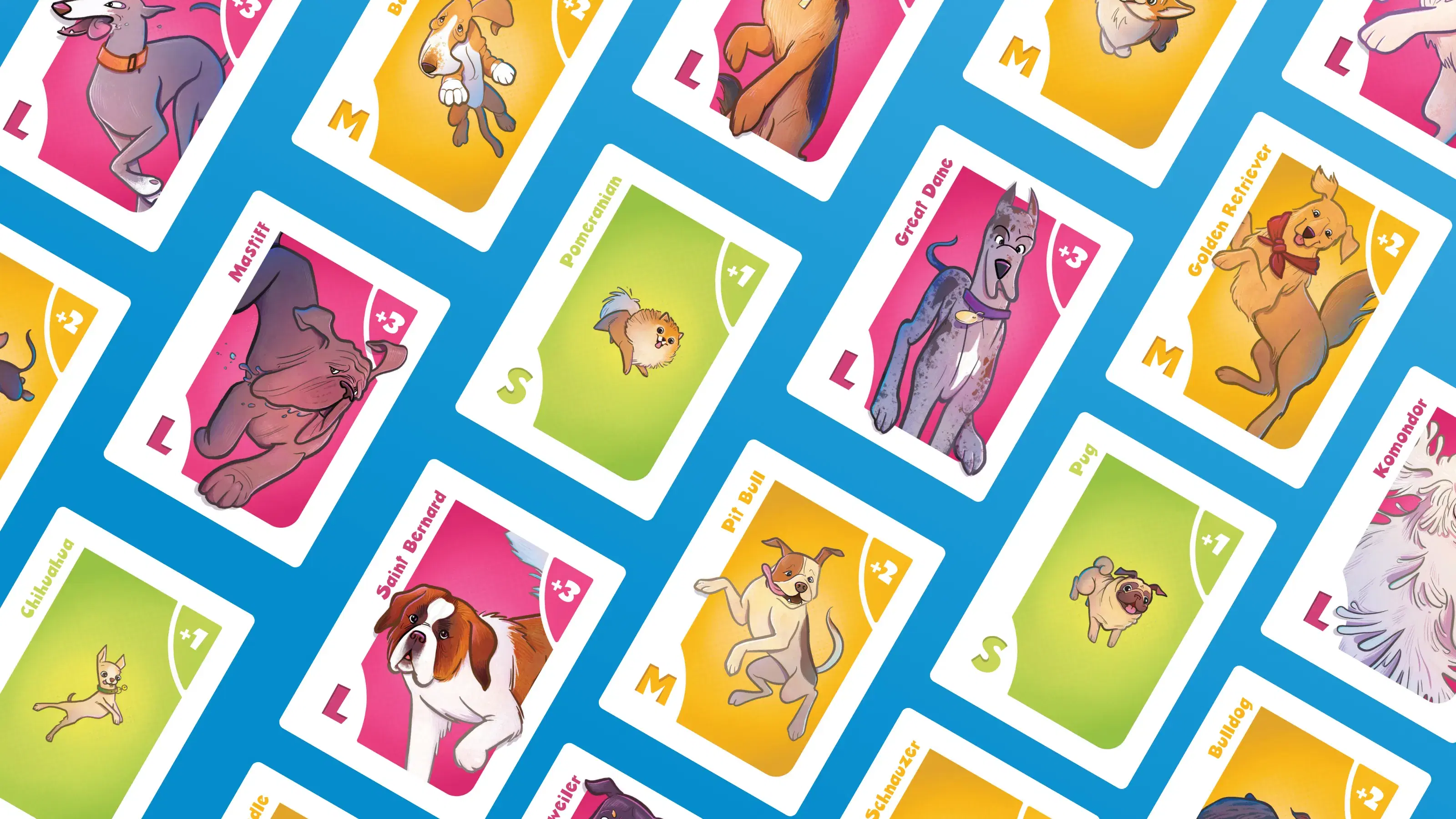
Quick Game Details: What is Dog Pile?
- Dog Pile is a press-your-luck party game for 2-6 players that can be completed in 15 minutes for players aged 6 and over.
- In Dog Pile, players compete to build the biggest (and most valuable) pile of dogs before claiming it at just the right moment.
- During the game, players work to build the best piles, rack up the most points, and prove who’s the top dog!
- Created by game designer Neal Hooper , Dog Pile includes a “careful blend of mechanics, adorable artwork by the wonderful Sarah VanDam , and high-energy gameplay that will make this game stand out in your collection because it’s not quite like anything you’ve played before.”
Welcome to the Dog Pile
Under all of the cuteness and tail wags, Dog Pile is a press-your-luck card game where you collect the most points as you play and claim the best dog piles to become top dog and win!
As Neal describes, “with Dog Pile we are really striving for a delicate blend of press-your-luck, real-time action, and satisfying strategy.”
The challenge is deciding when to cash in. Claim a pile too early, and you might miss out on valuable points. Wait too long, and another player could swoop in to claim it — or interrupt your plans with a perfectly timed matching card!
That’s where the game's real-time action comes in. When a player has an exact match for the top dog card, they can shout “Dog Pile!” and play it immediately, even when it's not their turn.
They then get a bonus turn, creating an opportunity to add another dog or claim the pile. But other players holding the same matching card can jump in, too, turning one quick play into a chain reaction of competing dog cards.

A board game designer and the creator behind Good Apple Games, where he focuses on making approachable, engaging games that bring people together. A husband, father of four, and lifelong lover of games, Neal especially enjoys designing games that are a delicate blend of approachable and strategic.
When he’s not designing games, you’ll probably find him playing them with his family, hiking, looking for tasty food, or uploading board games content to his social media.
From Stacks of Burgers to a Dog Pile
Even when a designer has a solid idea for a game’s mechanics, the theme can sometimes take extra time to cook up. And in the case of Dog Pile, the original concept had a decidedly different flavor.
For Neal, the basic concept of “stacking related cards and claiming the piles” was always in play. However, when asked about his original theme, Neal reflects that it had nothing to do with dogs and was “going to be about hamburgers, believe it or not.”
But when Neal did some research, he quickly realized that burger ingredients had already inspired a surprising number of card games. Which meant it was time to head back to the drawing board and find a theme that better suited the game's mechanics.
Sniffing Out Inspiration
Neal wanted something that captured the energy of stacking cards while making the act of piling them on top of one another feel natural. Then, a childhood memory provided the perfect inspiration:
“When I was a very young kid (5 years old?) I have a vivid memory of playing with my cousins and doing a massive dog pile in their living room [...] and just laughing so hard and having fun,” Neal explains. “That’s the exact energy I hope people have playing Dog Pile.”
With that memory in mind, he chased the idea down a brainstorming rabbit hole, and the “Dog Pile theme came [to him] one day, and it just felt so right.”
In fact, Neal observes that the name Dog Pile was “quite the lightbulb moment” that connected the game’s central mechanic with the kind of joyful, slightly chaotic fun Neal wanted players to experience.
And just like that, the burger stacks became a whole lot furrier!
Personalizing Dog Pile to Pawfection
Game development is rarely impersonal, and Neal roots his love of people and family in every design decision.
Neal is a dad of four who enjoys connecting with new people, and he cherishes the “kind of fun where everyone is involved, laughing, and even getting a little competitive.”
For him, an individual’s uniqueness is a strength, not a weakness, and bringing different personalities together is a core motivator with Dog Pile.
Neal explains there’s “something wonderful about seeing kids and adults equally invested in a shared experience,” and hopes to pull away from the trend that classifies “kids’ games” separately from everything else. Instead, his goal is to “put out games that are equally enjoyed by everyone.”
Pawing Through the Design Process
Neal describes Dog Pile’s development as a “labor of love,” sharing that the first iteration was playtested almost three years ago. Since then, the game has been adjusted, edited, and pawed to perfection.
With major changes to the “amount of real-time action and swingy action cards,” Neal shares that “the game has really evolved quite a bit since its inception.”
Let’s dive in and take a closer look at his journey through that process.
Ruff Around the Edges: From Chaos and Simultaneous Play to Stacked Strategy
Balancing strategy, luck, and the real-time action in Dog Pile was a huge undertaking.
Neal shares, “Originally the game was much more chaotic and leaned too heavily on the real-time mechanic with multiple piles and simultaneous play.”
While these game mechanics seemed crucial, after playing through the game, Neal found that finishing the game left something to be desired — and it wasn’t another play through.
To combat these challenges, he adjusted the game to allow “unique scoring bonuses based on the order you stacked the dogs.” But even that adjustment caused problems when he realized the new strategy elements were “not enjoyable for younger players” and made “end-game scoring a lengthy chore” rather than a victorious celebration, causing him to continue tweaking the game’s mechanics.
Multiple Pup Piles: Crazy or Barkitecture Genius?
One of the most exciting developments came from an unexpected source: feedback from fellow game developers.
Neal initially assumed that allowing multiple dog piles would make the game more fun. But he realized that letting several players start separate piles could take away from the excitement of the original “Dog Pile!” moment.
Then, during playtesting with developers from Outset Media , they challenged him to try something different: let multiple players jump in on the same matching dog card.
Neal gave the idea another chance, and the results were hard to ignore.
“Well, I playtested it, and the energy was off-the-charts,” he recalls. “So needless to say that is now etched in stone in the rulebook.” That change helped turn “Dog Pile!’ into the lively interruption mechanic players know today.
Rather than splitting the action across several piles, everyone has a chance to react to the same moment, keeping the competition focused and the excitement contagious.
Stay Fetchy & Keep the Pile Moving
Some of the most important design changes are the ones that seem almost invisible.
In an earlier version of Dog Pile, the player who claimed a pile with a small dog was also responsible for starting the next one. On paper, it made perfect sense: you claimed the pile, so you started the next pile.
But after watching players play the game again and again, Neal noticed something that wasn't quite working.
Once a player claimed a pile, they had to gather up their cards, shuffle them into their kennel, draw back up to five cards, and then choose a new dog to start the next pile. It might only take five to eight seconds, but those few seconds were enough to interrupt the momentum of the game.
“I saw players naturally wanting to skip to the following player in clockwise order when starting a new pile over and over,” Neal explains.
So he changed the rule.
Now, when a pile is claimed, the next player in clockwise order starts the new pile. It's a small adjustment, but it keeps the action moving and lets the player who just claimed their pile take a moment to organize their cards without bringing the whole table to a stop.
Playtesting: A Little Help From the Pack
Neal's development journey wasn't a solo effort. In fact, some of Dog Pile’s most important ideas came from the people closest to him.
Reflecting on the development experience, Neal shared: “One thing that makes Dog Pile special to me is how much my friends’ and family’s input ended up in the finished game.”
For example, his nieces and nephews became some of his most loyal playtesters, and their feedback “genuinely changed how the game works.” In fact, one of their suggestions became a major part of the game’s strategy: players should only be able to play a dog of the same size or smaller on top of the current dog.
At first, Neal wasn't convinced.
“I resisted the feedback because I thought it was going to make the game overly complicated,” he admits. But once he saw the rule in action during playtesting, he realized it added something important. Suddenly, when you played, your medium and large dogs mattered just as much as which dogs you had. The restriction created meaningful choices around timing and became a key part of the game's strategy.
Then his sister-in-law, Jenny Gibbons, suggested assigning the dog sizes different point values: one point for small dogs, two for medium, and three for large.
“BRILLIANT!” Neal says.
And the family feedback didn't stop with the gameplay. Another sister-in-law noticed something much more practical: the size indicator on each card wasn't as easy to spot when players were holding a fan of cards. Her suggestion to move the S, M, and L indicators to the bottom-left corner made the cards easier to read at a glance.
“I married into a smart family!” Neal jokes.
In fact, Neal’s wife was instrumental in the process, “enduring countless hours of back-and-forth tweaks on the game” that helped him finalize the theme, mechanics, and more.
Lastly, friends and coworkers helped Neal “playtest, tweak, and encourage the design,” making the release of Dog Pile more than just a new game on the shelves, but a community triumph.
These might seem like small changes individually, but with each playtest, Dog Pile moved closer to the balance Neal was looking for: strategy, luck, and real-time action, all working together without one element taking over the experience.
Un-Fur-Gettable Memories & Family Fun
With Dog Pile, Neal wanted to capture the excitement of the real-time card games he loved growing up, including Speed, Egyptian War, and Slap Jack, without making the experience too intense for players who prefer a more relaxed pace.
That meant creating a game where quick reactions matter, but don't overshadow the decisions players make on their turns.
The finished game blends accessible rules with enough tactical choices to keep everyone involved. Neal envisions “families gravitating toward the fun artwork and engaging gameplay.”
Players must weigh the value of building a bigger pile against the risk of losing the opportunity to claim it, all while watching for matching cards that could change the situation in an instant.
It's also a game designed to bring different generations together — “I made this game for people wanting to connect around the table. Families, friends, date nights. I love that the game can be enjoyed by diverse age groups and it always lands,” Neal shares.
His goal is simple: “I want every player who picks up Dog Pile to walk away with a smile on their face and lots of fun memories.”
When the Pile Comes Together
When Neal Hooper looks back at the journey of Dog Pile, it's difficult for him to choose just one thing he's most proud of. In the end, though, it may simply be the fact that he followed through.
Having an idea for a game is one thing. Turning that idea into something people can actually open, learn, and enjoy is another.
Dog Pile took countless hours of testing, tweaking, redesigning, playtesting, reworking — and as Neal observes, “a willingness to let go of ideas you thought were great,” but aren’t serving the game anymore, “is one of the hardest things to do as a game designer.”
And while Neal is proud of what made it into the final game, there's one thing he may never hear the end of: all the dog breeds that didn't make the cut: “Maybe we can fix that in a future expansion???” Neal teases, accompanied by a mischievous smile.
Jokes aside, what makes Dog Pile especially meaningful to Neal is how many people he can see in the finished game. His family, friends, coworkers, fellow designers, and playtesters all contributed ideas that helped shape it into what it became.
“I love that I can look at the finished game and recognize those contributions,” he says.
Dog Pile isn't something he created alone, and getting to share that experience with people he cares about, “and knowing their ideas are now part of something other families will play together, is pretty special.”
And if Dog Pile is any indication, this is only the beginning. Neal already has more games in the works, and he can't wait to share what's next.
Now it’s your turn to become part of the story — gather your favorite people, get Dog Pile to the table, and see who will become top dog!
Start the Conversation