
We Opened WHATEVER to House Rules & We All Caught a Case of Auction Fever
We Opened WHATEVER to House Rules & We All Caught a Case of Auction Fever
Are you familiar with the emotional state where bidders in an auction throw all caution to the wind, abandon their pre-set limits, and chase the thrill of winning above all else? No?
Well, that’s auction fever, also commonly known as auction madness — and my entire friend group has been infected with a very serious case of this phenomenon…in the best way ever.
Regardless of your experience with card games, auctions, and bidding wars, I can tell you that after we allowed some of our house rules into WHATEVER , this simple game quickly transformed from exciting and chaotic to a complete runaway auction.
Let me tell you all about it.
Quick Game Details About WHATEVER
- WHATEVER is a speedy card game that can be completed in 15 minutes, accommodates 2-6 players, and is suitable for ages 8 and over.
- Filled with harmless deceit, WHATEVER encourages players to bluff, beg, and barter their way to victory.
- Instantly immersive, unpredictable, and virtually genre-less, WHATEVER is a game that universally captivates players regardless of differences in age, gaming interests, or backgrounds.
- Easy to deploy, this game only requires cards and tokens, offering easy setup, instant gratification, and endless replayability.
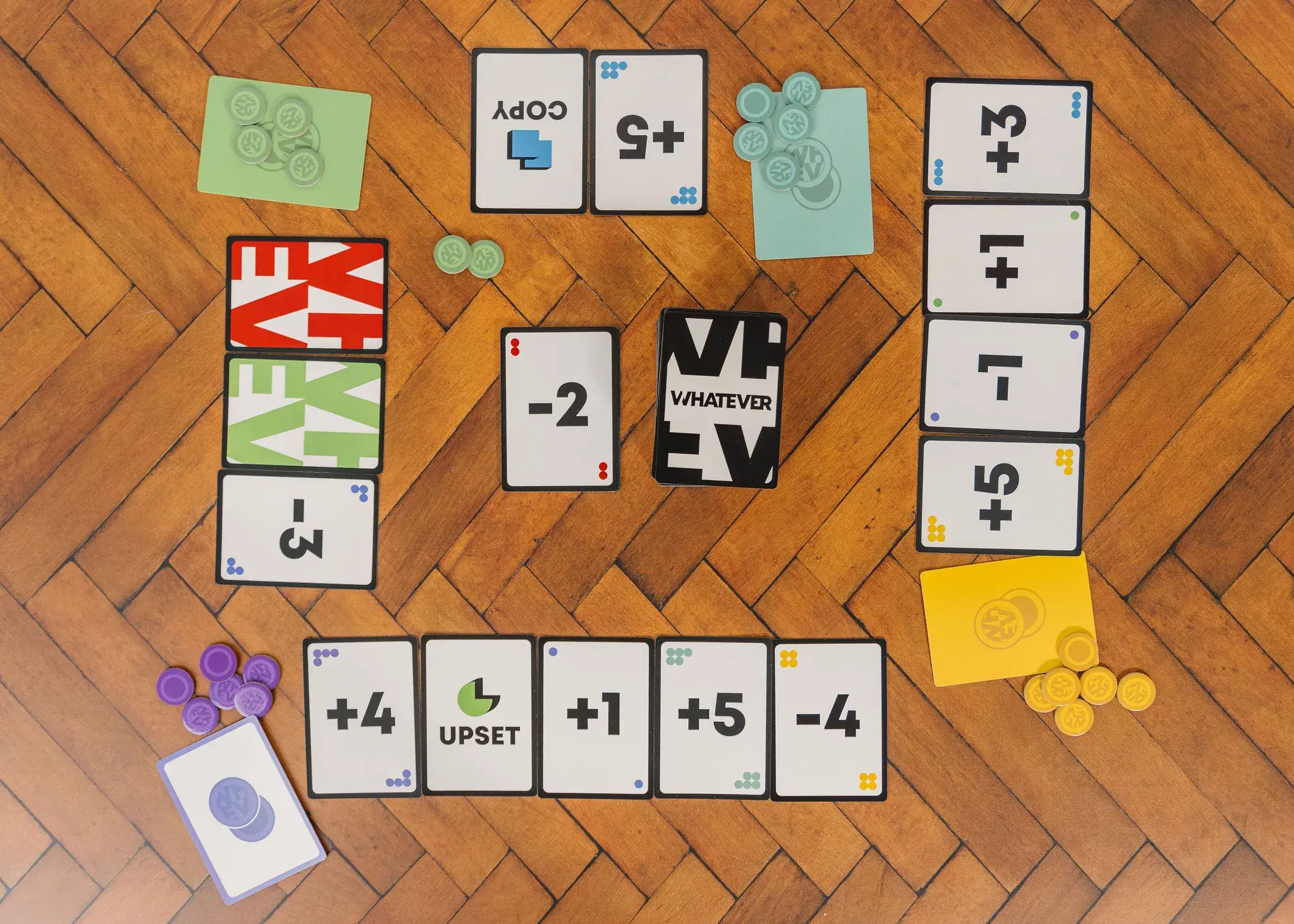
I’ll Play WHATEVER: Perfect, I’ll Go Grab It
Puns notwithstanding, WHATEVER was originally created by Talon Durrant , a game designer and owner of Sodalite Games , with a love for writing, websites, family, and board games.
When asked about what inspired WHATEVER, Talon reflects:
WHATEVER was inspired by two things: 1. Creating a game that allowed me to make a terrible, eye-roll worthy pun every time somebody didn’t know what to play, and 2. Creating a game that caught the magic of those card games you’ll pull out anywhere with anyone, and play over and over.
What are the Original Rules of WHATEVER?
Before we dive into some of the alternative rules for this card game, we need to cover what the original rules are.
Claim Your Bid Card & Tokens
Shuffle all the cards, and ensure each player receives a Bid card and 6 tokens of one color.
Play Auctioneer
On your turn, draw a hidden card from the deck and put it up for secret Auction, allowing players to Bid or Pass on the unknown card.
Give Your Best Bluff
Use your cunning to convince fellow players whether they should risk it all for the secret WHATEVER, Point, Copy, Upset, or Trash card that is up for grabs. Players Bid Tokens to win the mystery card.
Take Risks & Build Your Row
Slowly build your Row as you successfully win and exchange cards during the game.
Win…or WHATEVER
The winner is the first player with 10 or more points OR 3 or more WHATEVER cards in their Row.
How Do the Cards Work?
The simple concept of the game is complemented by a robust economic engine running just below the surface. The positive and negative number cards are pretty self-explanatory, in that they add, or takeaway, from the value of your Row.
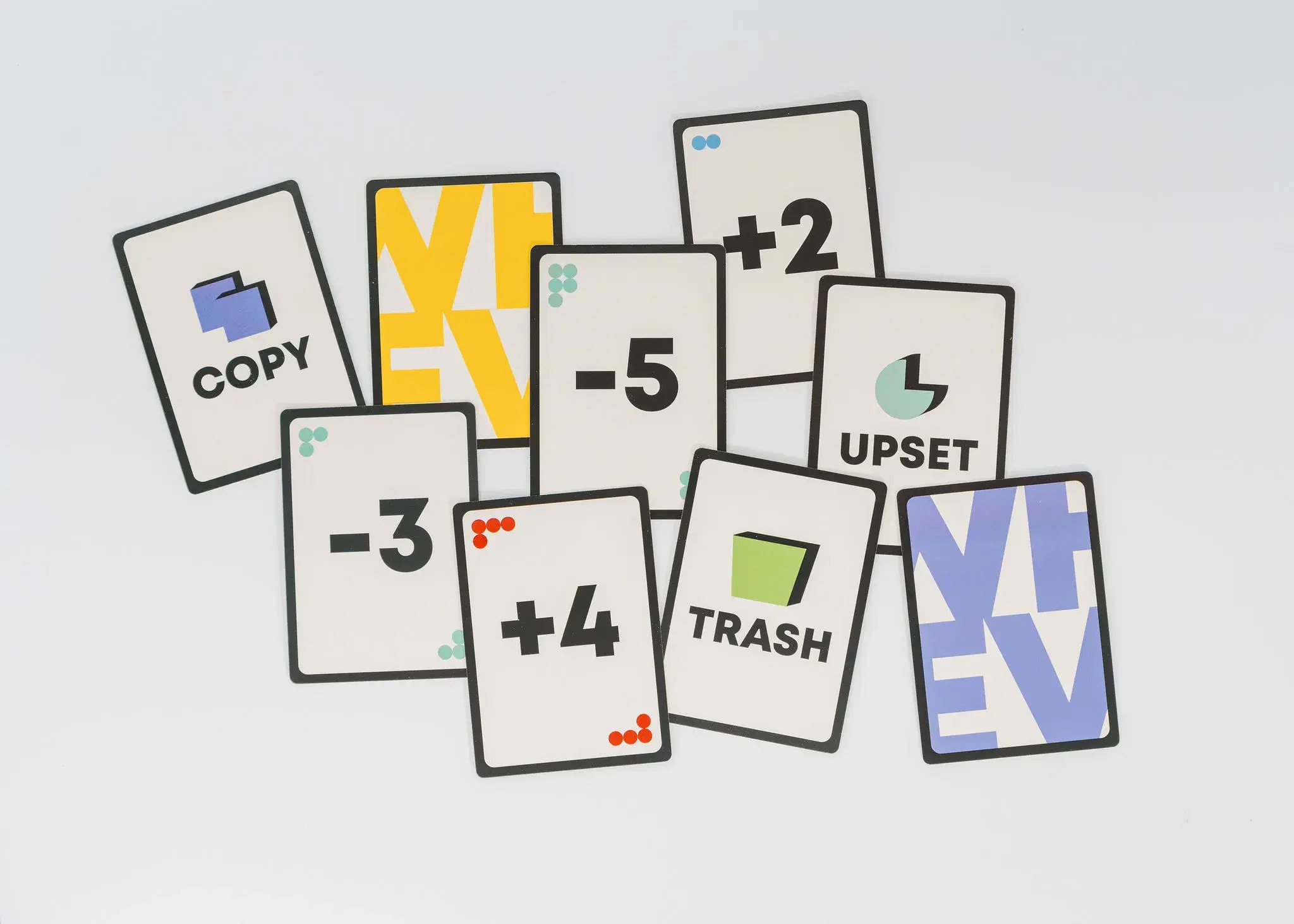
However, the WHATEVER specialty cards all have different purposes:
 | TrashDiscards itself and the card to its immediate left. | ||||
 | CopyCopies the card to its immediate left. | ||||
 | UpsetConverts the total of all cards to its left from positive to negative, or vice versa. | ||||
 | WhateverDiscards every card in your row, except for itself and any other Whatever cards. If you end up with 3 Whatever cards in your row (including Copy cards), you win immediately! | ||||
Strategically combining cards to win is a legitimate strategy — just think, one Upset card could turn an entirely negative Row into the highest-scoring Row in an instant.
Real Player Reactions to WHATEVER: Irrational Exuberance
First-time players of WHATEVER get immediately hooked, myself included, with the most common reaction being:
“NOO! I shouldn’t have (insert whatever they did or did not do)!”
Followed immediately by the player throwing up their arms and jokingly saying, “whatever!”
WHATEVER is so low stakes that victory is fun, but sometimes catastrophes are even better because of the group’s explosive reaction to big moments.
Unique Gameplay Tactics
There’s not one way to play the game, in fact, you can try WHATEVER you want.
Some players react in the moment to each card they receive, trying to approach each move with tactical precision, while others just collect what they can and see what happens.
Other players hoard tokens (at the expense of the other players), or spend them gleefully — becoming a broken “I pass” record until they finally have the chance to be the Auctioneer.
What’s fun for players is that your choices have consequences, but you don’t always get to know WHAT you’re actually choosing.
House Rules, Roleplay, and Chumming the Water for Sharks
There’s really no right or wrong way to play, in fact, it really is WHATEVER.
And what we’ve found is that the simple ruleset and replayable nature of the game has led to the emergence of a lot of “house rules.”
Colors Matter in Bidding
If you incorporate this house rule into WHATEVER, you can outbid people by either playing more tokens, or by playing more unique colors of tokens.
For example, based on this rule, bidding two tokens of unique colors (1 red token and 1 blue token) would outbid two tokens of the same color (2 red tokens).
To encourage this color-based bidding rule, you can implement an alternative game setup where each player starts with one token of each color (instead of all tokens in a single color).
Suggested By: Chris B.
Starting Bank: Make Way for Immediate Exchanges
Another WHATEVER house rule you can try is beginning the game with a starting bank.
This optional rule maintains the game’s economy, but gives players immediate access to all of the game mechanics by making it possible for Exchanges to happen right off the bat.
For this version, you can use 6 black or 6 white tokens to start at the center, serving as the bank.
Auctioneers: Only Speak the Truth…Sorta
I don’t think anyone would want to play WHATEVER with a house rule where the Auctioneer ALWAYS tells the truth, but in this version of the game, the Auctioneer is required to share SOME truth with the other players.
When playing with this house rule, when the Auctioneer draws the secret card, they are obligated to announce (truthfully) what color set the card belongs to.
This information informs players of the potential value (or lack thereof) of the secret card, giving them a tiny hint about how they should bid.
As players get more familiar with the color sets, it requires serious effort on the Auctioneer’s part to deceive the players about the secret card.
Suggested By: Nathan G.
Second Chances: Make Way for the Comeback
As we mentioned earlier, one of the most common reactions to WHATEVER is the “I wish I would have…” statement. This house rule gives you the chance to catch your mistake before it’s too late.
During game setup, give each player an additional token (either black or white).
For the duration of the game, any player can sacrifice a token of that color into the middle to “unpass” and re-enter bidding — effectively giving them a second chance at winning the secret card.
Players can exchange cards to retrieve that color of token back from the center, or simply use it for regular bids.
Extension of Poker Night or a Feast of Treats?
Some players want to make the game feel more like poker night, replacing the included game tokens with their own poker chips, giving a unique, adults-only spin to the gameplay.
Alternatively, you could try swapping the tokens with delicious chocolate coins wrapped in gold foil, making victory that much sweeter.
Whether WHATEVER finds its place at your table during guy’s night or family night, players are constantly finding ways to make the stakes even higher.

Roleplay Fanatics
You can also take WHATEVER to another level by locking into the auction aspect of the game.
For example, some groups have gone so far as to purchase a gavel that can be passed around to the Auctioneer, with homemade bidding paddles for each player.
Okay, so maybe we made this house rule up (we do WHATEVER we want) — but if any of you actually do try this out, please send us pictures…
Auctioneering Addicts
The great thing about WHATEVER is that any tactics or skills that you bring to the table can work to your advantage (or not).
You can try to incorporate real auctioneering and bidding tactics, like accelerating the pace of bids with a timer to increase competition and urgency during each round, similar to stimulating feeding frenzies in sharks (you were already wondering how chumming the waters fit in with this topic, weren’t you?).
Alternatively, you can try your hand at “shill bidding,” where you try to generate interest in a card artificially, and then pass on it yourself, or successfully convince your competitors to invest all of their tokens in a Trash card.
The Possibilities Are Endless: Try WHATEVER You Want
Were you inspired to try any of these variant house rules? Or, did you already come up with something uniquely your own?
WHATEVER the case, we’d love to hear about your experiences with the game.
Was there a major Upset at the last second, a shrewd Auctioneer who duped you into buying a Copy card right at the worst-possible moment, or a go-with-the-flow player who just kept winning by mere chance?
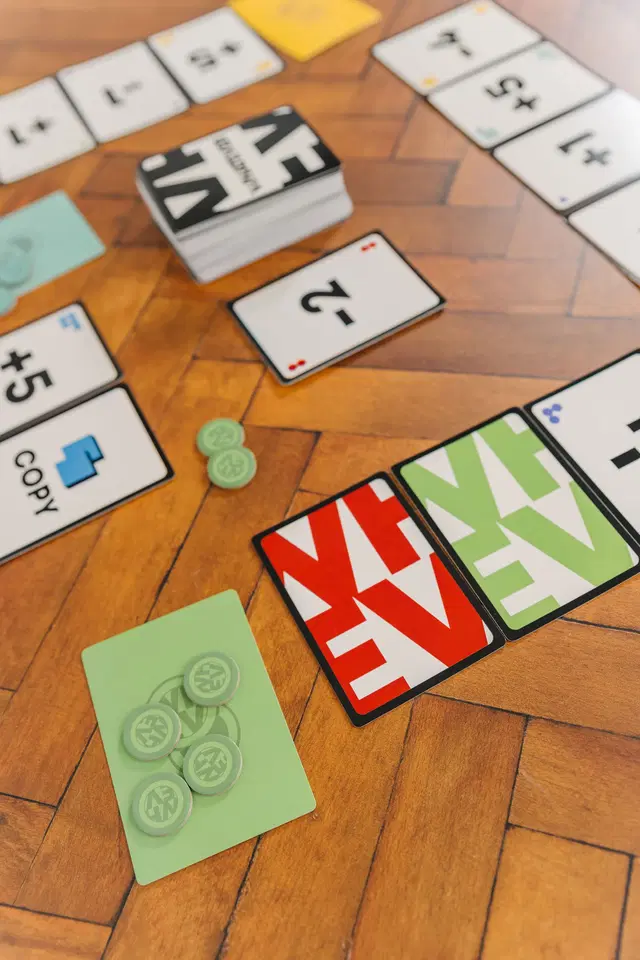
All this and more with WHATEVER — the easy-to-play card game where you bluff, beg, and barter your way to success.
Continue Reading
- Hack Attack Has Found a New Home Read the Story
- We Made a Secret Game to Give You for Free, But Forgot to Tell You About It…Until Now!Read the Story
- Why Did We Decide to Create a Card Game About Cybersecurity?Read the Story