
Firework Frenzy: From a Game Design Experiment to a Fireworks-Fueled Showdown
Firework Frenzy: From a Game Design Experiment to a Fireworks-Fueled Showdown
What happens when rival fireworks shops will do anything to steal the holiday crowd? In Firework Frenzy, the answer is a chaotic mix of dice rolls, sneaky sabotage, and spectacular comebacks. One lucky roll might save your inventory, while a well-timed action card could leave your biggest rival watching their fireworks go up in smoke.
Designed by Hayden Dille, Firework Frenzy is a fast-paced dice-and-card game that blends luck with strategy. But before rival fireworks shops entered the picture, the game took a very different form, evolving through mythical monsters, Greek mythology, and several major design changes.
So how did Hayden turn those early concepts into the explosive party game it is today? Let's explore the twists, turns, and creative decisions behind Firework Frenzy.
Quick Game Details: What is Firework Frenzy?
- Firework Frenzy is an exciting roll-and-card game for 2-8 players that is playable in 15-30 minutes and suitable for ages 8 and over.
- In Firework Frenzy, players run rival pop-up firework shops, battling to sabotage each other’s inventory and steal all the customers for themselves. Expect quick turns, big reactions, plenty of laughs, and more than a few outbursts between friends.
- During the game, Firework Fred runs the permanent local shop and can join the fray, especially in two-player games. As the competition heats up, players are eliminated until only two remain — then it’s time for the Final Showdown, where the rules change, and anything can happen.
- Created by game designer Hayden Dille , the game is intended to be an exciting “blend of strategy and luck, where players feel both strategic when they win and can blame it on bad luck when they lose.”
Lighting the Fuse on Firework Frenzy
At its core, Firework Frenzy is an elimination game where players run rival pop-up fireworks shops. However, success isn't simply a matter of building the best inventory, players also have to contend with opponents who are more than happy to disrupt their plans by sabotaging their inventory and stealing all the customers.
That creates a lively balance between luck, strategy, and player interaction.
When asked about the game, Hayden shares that “if you want to have a quick, delightful game that can have your table laughing and cursing each other’s name within minutes of each other, this is the game for you.”
Dice bring even more unpredictability to the experience, while cards give players opportunities to influence what happens next. Meanwhile, sabotage keeps everyone watching the table. A player who seems comfortably ahead can suddenly find themselves in trouble, and an opponent who looked out of the running may still have a chance to turn things around.
The result is a quick, mischievous experience that encourages players to take risks, watch their rivals, and enjoy the chaos along the way.

A data analyst from the United States who has been designing board games since he was a kid and just recently discovered it was a thing. His proudest achievement was getting his wife into board games, and when his toddler is old enough, his second proudest achievement will be getting him into them too.
The Right Spark at the Right Time
Sometimes, an early concept contains the spark of something great, but the timing isn’t quite right.
Originally, Hayden wanted to design a massively detailed, in-depth game set on Mars that centered around “colonization-themed worker placement.” But after some well-timed podcast advice, Hayden realized that trying to design a “complex game right out of the gate was like trying to paint the Mona Lisa or Sistine Chapel when you’ve never even painted before.”
As a result, Hayden’s new goal was to create his first game in a more approachable format that could still deliver quick turns, meaningful decisions, and plenty of opportunities for players to interfere with one another — and that’s when the idea became clear.
Hayden planned to start his foray into game design with a completely different roll-and-write game, like Yahtzee.
The Pivotal Pop That Changed Everything
During his initial planning for a roll-and-write game, Hayden had to “ponder the economics of creating a bunch of pencils to send with the game,” wondering whether the game needed pencils at all.
Everything shifted when he started thinking about alternatives to pencils and what that could look like. Suddenly it dawned on him: the game “could just have face cards” that represent all the possible results (2–12) of rolling two dice.
It was at this moment that Hayden reflected that the “game took off from there.”
Subverting Expectations: An Explosive Yahtzee Variation
Unlike Yahtzee, Hayden designed Firework Frenzy to take the gameplay intensity up a notch. Rather than simply competing for the best score at the end, he turned it into an elimination game that culminates in a Final Showdown, which determines the last shop owner standing.
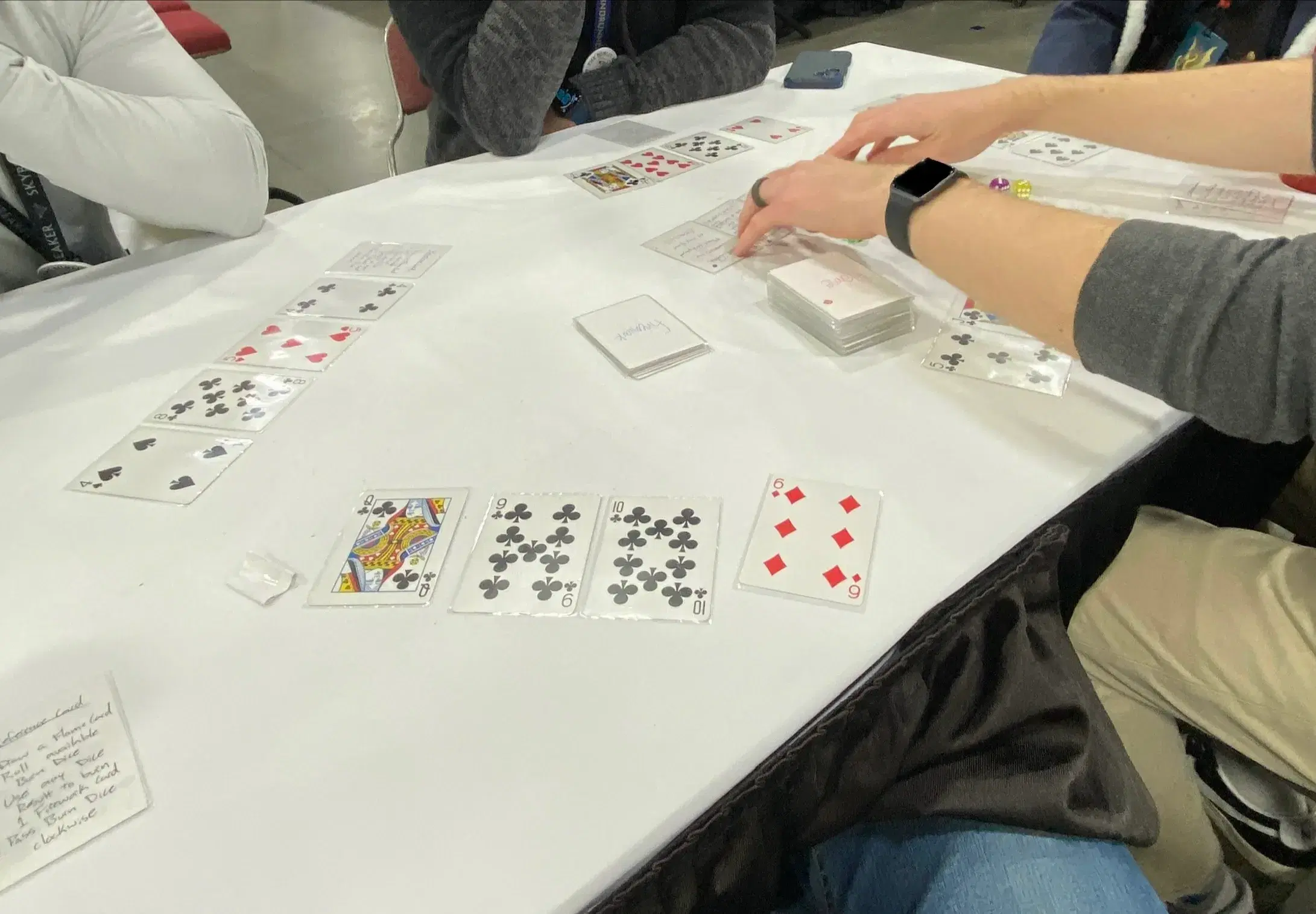
This game also features a unique gameplay mechanic; instead of writing down the results of your dice rolls, players are given cards with values to roll and match, offering a fresh new roll-and-card concept.
In fact, Hayden observes that “as far as [he knows] there is not a roll-and-card (play on roll-and-write) game out there, so it definitely has that uniqueness factor going for it.”
While the game is very straightforward, it’s not oversimplified — the game includes action cards that give players special powers like modifying rolls to manipulate sales or protect valuable firework cards.
Before Fireworks, There Were Monsters & Greek Mythology
Designing Firework Frenzy was a years-long process. Hayden shares that he’s been working on the game “since January 2023,” marking nearly four years of development.
During that time, Hayden explored other thematic directions, including Mythical Gym and Greek boxing before Firework Frenzy became a game about competing firework shops.
Mythical Gym
Originally, Firework Frenzy was called Mythical Gym, a solo game where players took on the role of monsters training to defend their loot from would-be hero thieves.
Players would train to unlock special abilities before facing off against a series of heroes, each with their own deck of ability cards. With every victory, the challenge grew tougher, turning each successive battle into an increasingly difficult test of the players’ skills.
Greek Boxing
Over time, Mythical Gym evolved into a Greek mythology-inspired boxing game. Players each chose a monster with its own specialty, then trained at the gym to improve their abilities before facing off in the boxing ring.
Unlike the original solo game, this version was designed exclusively for two players, with head-to-head competition that shared some similarities with the current Firework Frenzy gameplay, but much simpler, featuring just four types of action cards.
The Game Convention That Changed Everything
While continuing to develop the game behind the scenes, Hayden attended a game convention where a new concept took flight.
As he browsed the games available, he started “getting tired of looking at all the similarly themed games,” realizing that “they started to blend together.”
This realization made him rethink the direction of the game entirely. While he was passionate about Greek mythology, he decided it might be time to consider a theme he was still enthusiastic about, but offered broader appeal.
During this phase, Hayden thought, “What could be more universal than fireworks?” After all, “so many cultures love them,” and he had “a lot of fun memories with them as a kid.”
Browsing the game landscape, he also discovered that there aren’t a lot of existing fireworks games, and so he felt that was a “real miss” and that this could be the perfect opportunity.
Why Fireworks Became the Perfect Theme
He was pleased to discover that fireworks were the perfect fit — rival pop-up shops competing for holiday customers offered a natural reason for players to sabotage one another, while the fireworks theme gave the game an energetic, celebratory atmosphere.
The name Firework Frenzy was coined by Hayden’s wife during a brainstorming session where they “were just trying to figure out firework-themed names, and that was the one that best invoked the chaotic nature of the cards!”
The name captures that combination perfectly. It promises excitement, disorder, and the possibility that everything could change in an instant.
And, as anyone who has played a competitive party game knows, that uncertainty is often where the best moments happen.
Balancing Luck, Strategy, and a Little Sabotage
For a game designed to bring big reactions to the table, balance is important. The challenge is finding a sweet spot where the unexpected keeps things exciting without making player choices irrelevant.
Getting the Right Sparks to Fly: More Card Types & Combinations
As Firework Frenzy evolved, one of the biggest design challenges was figuring out the right combination of abilities.
Hayden reflects that “there were so many possible powers” to choose from that finding cards that fit the game's theme, worked well together, and remained balanced was not only “tricky,” but took careful consideration.
But the changes went beyond the cards themselves. Moving away from the original training phase helped take the game “to the next level”, while expanding beyond the four action card types opened the door to more possibilities.
And for fans who enjoy a good pop-culture reference, keep an eye out for the “Aggressive Negotiations” card. Its name is a subtle nod to Star Wars, adding a little extra fun for players who catch the reference.
Balancing the Firework Display
One of the biggest surprises during Firework Frenzy’s development was how naturally the game balanced itself.
Although luck can sometimes give a player an advantage, Hayden found that social dynamics often had a bigger impact on the outcome. When someone starts pulling ahead, the other players tend to team up to take them down!
As a result, it's rare for anyone to win with more than two cards.
Meet Firework Fred, The Permanent Shop in Town
Unlike the players' temporary shops, Firework Fred runs a permanent firework shop. He can join two-player games or games with more players if the group wants him in the mix.
This makes Fred a flexible addition to the competition, especially when there are fewer players at the table. Rather than requiring a larger group to enjoy the game, Firework Frenzy can bring its explosive rivalry to smaller gatherings, too.
Of course, a permanent shop doesn't mean the competition is any less chaotic. When everyone is fighting for the holiday customers, even Fred can become part of the frenzy!
Keeping Everyone in the Game Until the Grand Finale
Elimination can be a tricky mechanic in a party game. It creates tension because players know they could be knocked out of the competition, but it can also leave someone sitting on the sidelines.
For Firework Frenzy, keeping eliminated players involved was an important part of the game’s development.
Spectator rolls allow eliminated players to stay engaged with the action instead of simply waiting for the game to end. This helps preserve the social energy around the table, even when someone’s shop is no longer competing for customers.
And with rivals sabotaging one another throughout the game, there's rarely a shortage of action to watch.
The Moments Worth Celebrating
For Hayden, the goal is for players to walk away from Firework Frenzy feeling like they've been part of something memorable.
A victory should feel earned, with just enough luck mixed in to make the win even sweeter. And even if players lose, he hopes they’re left thinking, “Dang! I was so close!” or remembering an epic showdown between the final two players.
Most of all, he hopes there are “a few moments [players] leave chatting about” long after the game ends. Maybe a rogue mortar burns through half the cards, or Mom somehow rolls a combination that matches her own firework card, causing her to burn out during the Final Showdown. What are the odds?!
These explosive surprises make every game different — and give players something to laugh about, debate, and retell long after the fireworks have faded.
A Firework Frenzy for Every Game Night
When designing Firework Frenzy, Hayden had a few groups in mind, especially families with tweens and teens looking for a fun addition to game night. But he sees plenty of possibilities beyond the family table, too.
Couples can face off in two-player games, extended families can bring it out at reunions, and friends can squeeze in a quick round while waiting for everyone to arrive for a bigger game night.
In fact, Hayden was inspired by seeing a group of friends playing Coup at a pizza place. It got him thinking about how Firework Frenzy could fit into similar casual settings, where people can pull out a game, enjoy some friendly competition, and make a few memories together.
Whether it's a planned evening with the family or an impromptu game between friends, sometimes the best game-night memories come from the games you never planned to play.
One More Round? The Lasting Appeal of Firework Frenzy
Firework Frenzy shows how game designers can find the right starting point in an unexpected place. While a much larger Mars-themed game remains an idea for the future, it inspired a more approachable first project: a fast-paced elimination showdown between rival firework shops.
For Hayden Dille , his proudest moments are when “people play and want to immediately play again,” because “that feeling is like crack for a game designer” and is “a lot of fun.” Knowing that a game he created can bring people that much joy is an incredibly satisfying feeling, and it's what makes all the hard work worthwhile.
Now, he’s most excited for people to experience the fun for themselves. Ready to light the fuse? Gather your rivals, open your pop-up shops, and see who can survive in Firework Frenzy .
Start the Conversation